Pearson Edexcel · A-Level · English Literature
Course version: 9ET0 · Version from Sept 2015
Poetry – Section B: Specified Poetry Pre- or Post-1900 – Post-1900 – The…
Full specification wording
Component 3: Poetry – Section B: Specified Poetry Pre- or Post-1900 – Post-1900 – The Modernist Period – T S Eliot: Selected Poems (Faber, 2009): Whispers of Immortality
In 'Whispers of Immortality', T.S. Eliot contrasts the profound, death-obsessed vision of Jacobean dramatists with the superficiality of modern life.
Checked against the Pearson Edexcel 9ET0 specification (opens in a new tab) on .
- Point 2 of 7
- 4 key terms
Study notes
From the checked teaching notes for this specification point.
The idea
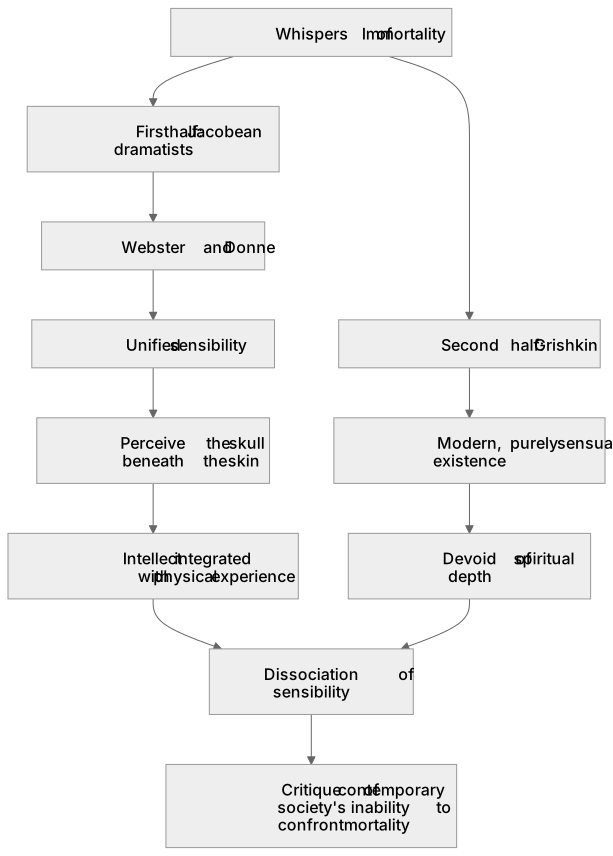
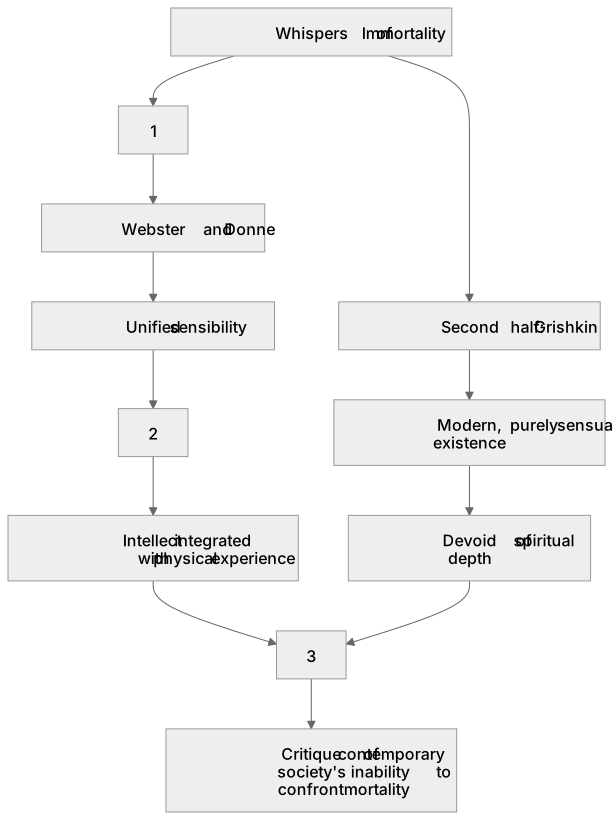
In 'Whispers of Immortality', T.S. Eliot contrasts the profound, death-obsessed vision of Jacobean dramatists with the superficiality of modern life. The first half praises John Webster and John Donne, who possessed a unified sensibility and could perceive the skull beneath the skin, integrating intellect with physical experience. The second half introduces Grishkin, a symbol of modern, purely sensual existence devoid of spiritual depth. Eliot uses this juxtaposition to explore his concept of the 'dissociation of sensibility', critiquing contemporary society's inability to confront mortality.
What earns the marks
- Analyse the allusions to Webster and Donne as representatives of a unified intellectual and sensory experience regarding mortality.
- Evaluate the contrast between the macabre, intellectualized death in the first half and the overwhelming, animalistic physicality of Grishkin in the second.
- Discuss Eliot's concept of the 'dissociation of sensibility' as it manifests in the poem's stark structural and thematic divide.
- Examine the use of sensory imagery, particularly scent such as the feline smell, to underscore the base, unspiritual nature of modern existence.
Common mistakes and how to put them right
Treating the poem as a simple character study of Grishkin.
Put it right: Analyse Grishkin as a symbol of modern spiritual emptiness contrasted with Jacobean depth.
Misunderstanding the title's reference.
Put it right: Note that it ironically echoes Wordsworth's 'Intimations of Immortality', replacing romantic hope with macabre reality.
Overlooking the significance of the metaphysical poets.
Put it right: Explicitly connect Webster and Donne to Eliot's critical theories on unified sensibility.
Exam tips
- Link the poem's thematic division to Eliot's critical essay 'The Metaphysical Poets' to access higher marks for contextual understanding.
- Contrast the skeletal, intellectual imagery of the first four stanzas with the fleshy, sensory imagery of the final four stanzas.
- Compare the figure of Grishkin with other spiritually vacant characters in Eliot's work, such as the typist in 'The Waste Land'.
Try the lesson
The start of the Component 3: Poetry – Section B: Specified Poetry Pre- or Post-1900 – Post-1900 – The Modernist Period – T S Eliot: Selected Poems (Faber, 2009): Whispers of Immortality lesson, made from checked teaching notes for this specification point.
Have a go first
In the opening stanzas of T.S. Eliot's 'Whispers of Immortality', which two Jacobean writers are presented as possessing a profound, visceral awareness of death and physical decay?
Listen
In 'Whispers of Immortality', T.S. Eliot contrasts the profound, death-obsessed vision of Jacobean dramatists with the superficiality of modern life. The first half praises John Webster and John Donne, who possessed a unified sensibility and could perceive the skull beneath the skin, integrating intellect with physical experience. The second half introduces Grishkin, a symbol of modern, purely sensual existence devoid of spiritual depth. Eliot uses this juxtaposition to explore his concept of the 'dissociation of sensibility', critiquing contemporary society's inability to confront mortality. A strong answer earns marks for these points. Analyse the allusions to Webster and Donne as representatives of a unified intellectual and sensory experience regarding mortality. Evaluate the contrast between the macabre, intellectualized death in the first half and the overwhelming, animalistic physicality of Grishkin in the second. Discuss Eliot's concept of the 'dissociation of sensibility' as it manifests in the poem's stark structural and thematic divide. Examine the use of sensory imagery, particularly scent such as the feline smell, to underscore the base, unspiritual nature of modern existence. A common slip: Treating the poem as a simple character study of Grishkin. Instead, analyse Grishkin as a symbol of modern spiritual emptiness contrasted with Jacobean depth. Exam tip: Link the poem's thematic division to Eliot's critical essay 'The Metaphysical Poets' to access higher marks for contextual understanding.
See it
Key words
Say what each word means before you turn the card.
Dissociation of sensibility
Try answering aloud or in your head before turning the card.
Death and mortality
Try answering aloud or in your head before turning the card.
Intellect versus physicality
Try answering aloud or in your head before turning the card.
Modern spiritual decay
Try answering aloud or in your head before turning the card.
See every definition
- Dissociation of sensibility
- Eliot's concept describing a modern inability to integrate intellect with physical experience, so that contemporary society cannot confront mortality.
- Death and mortality
- The inescapable reality emphasised through macabre imagery and strict quatrains, which the modern world is unable to confront.
- Intellect versus physicality
- The contrast between the macabre, intellectualised death of the first half and the overwhelming, animalistic physicality of Grishkin in the second.
- Modern spiritual decay
- The superficiality and spiritual emptiness of modern life, symbolised by Grishkin's purely sensual existence devoid of spiritual depth.
Label the diagram
Some boxes have lost their names. Pick the right name for each number.
1Box 1
2Box 2
3Box 3
There is more to this lesson
The full lesson goes on to check your understanding and help you earn the marks. Create a free account to carry on, with your progress saved.
A week of Premium from your first lesson · Then the free plan continues · No card, no charge
Test your understanding of Component 3: Poetry – Section B: Specified Poetry Pre- or Post-1900 – Post-1900 – The Modernist Period – T S Eliot: Selected Poems (Faber, 2009): Whispers of Immortality
Active recall beats re-reading. Take an instant quiz now to test what you’ve learned and lock it into long-term memory.
A week of Premium from your first lesson · Then the free plan continues · No card, no charge